

Forex Moving Average Crossover Strategy
In this all-encompassing article we will study the various kinds of crossovers and how to exploit, interpret and confirm them based on the interaction of indicators with the price and each other. We'll describe them in diverse charts to brand it easier for you every bit a reader to empathise. The crossover strategy is popular and piece of cake to utilise and identify, only information technology tin too be troublesome because of its tendency to generate alien and faux signals unless it is confirmed by other types of data.
Crossovers are thought to signal momentum change in the markets. When the main indicator crosses a predefined signal line, the trader volition interpret this as a warning sign that something is changing with respect to either momentum of the price activeness, or its direction. Just every bit we mentioned, crossovers are relatively common, and a strategy based on them solitary is unlikely to piece of work well in the absence of confirmation from other sources.
The signals generated past a crossover can exist useful in a ranging or trending market, simply in a trending market, a crossover is a less significant evolution than in a ranging market.
Let us examine the various basic crossover strategies.
Moving Boilerplate Crossovers
Moving average crossovers occur when a faster moving boilerplate rises higher up or falls beneath a slower ane. For example, when a 13-twenty-four hour period SMA (simple moving boilerplate) rises in a higher place a 100-day SMA, or when an 14-twenty-four hour period EMA falls below a l-solar day SMA, we will be studying a moving boilerplate crossover. In this type of crossover, the signal line is non static, and must be provided past the trader manually. This flexibility makes MA crossovers much more adaptable to changing market conditions, and in trending markets, MA's tin can be greatly useful for our trading choices.
MA crossovers can be useful for both range trading, and trend following, but since moving averages generate smoother and more reliable signals in trending markets with relatively depression volatility, the about successful use of the MA crossover is also in a trending market. Many traders choose to use a unproblematic moving average for the slower MA, and an exponential moving average for the fast component. But this is non a necessity. Depending on the preference of the trader with regard to indicator sensitivity to toll action, an EMA can be used or discarded altogether.
Larn more nigh simple moving average crossover strategy.
Learn more than well-nigh exponential moving average crossover strategy.
In this section we will examine v different strategies based on MA crossovers.
Moving Average crossovers with a breakout scenario
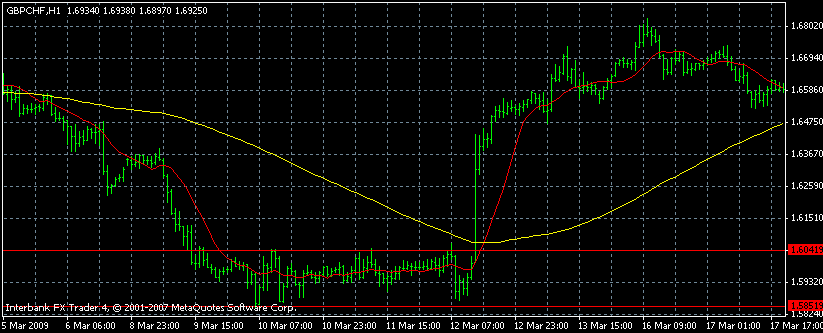
In this hourly chart of the GBP/CHF pair, nosotros see an approximately three-solar day long range pattern developing between i.5851 and one.6041 price levels, with the 13 hr MA depicted in blood-red remaining consistently beneath the xanthous 100-hour MA for the unabridged duration of this menstruation. The cost fluctuates between the temporary support and resistance lines (shown equally ruby-red lines on the graph), and the faster thirteen-hour moving average settles to a very quiet consolidating pattern in the same period. Neither the MA not the price action gives any meaningful betoken with respect to the hereafter, until the eventual breakout occurs.
At around five am on the twelfth March, we see a sudden spike in the price action, which chop-chop causes the more sensitive xiii-hour simple moving average to spike up also and eventually to rising higher up the yellow 100-hour simple moving boilerplate, and a crossover occurs, and afterward the price keeps rallying powerfully, reaching riught up to 1.68 eventually. In this scenario, the significance of the crossover is amplified past the long duration of the preceding consolidation blueprint, and the repose and subdued toll action. Since markets rarely remain and so quiet for a protracted period of time, the eventual crossover creates a very reliable signal for the vehement upswing of the toll.
Moving Average Crossovers with RSI
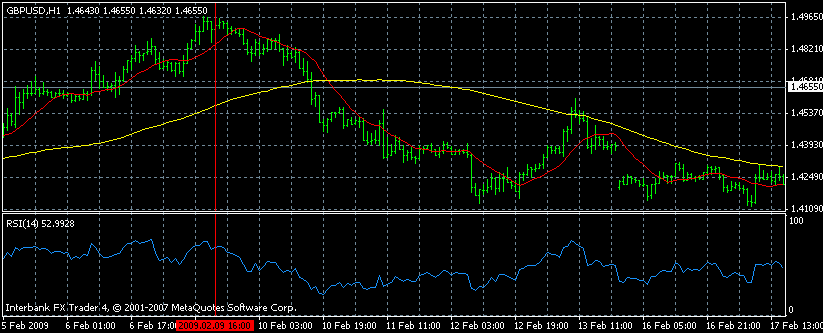
Before examining this nautical chart, let us first note that the moving average crossover, and the RSI are both lagging indicators. While using them together on a trend design to identify peak values, while filtering the simulated signals by usage of the crossover is surely possible, the trader must be judicious in selecting the more than reliable scenarios by concentrating on the near extreme indicator values. Learn more than nearly the RSI indicator here.
Here, as in the previous example, the yellow line is the 100-hr SMA, and the crimson line is the thirteen-24-hour interval SMA In this hourly chart of the GBP/USD pair we annotation that the RSI remained higher up 50, closing to and exceeding the 70 level for a number of times in the period leading to the MA crossover. A curt while after 9th February around 4 pm, when the price itself peaked, the RSI entered 2 solar day long downwards move which kept it under 50 for that menses. Similarly, around midday on tenth February, an MA crossover occurred, with ruddy 13-hour SMA moving below the yellow 100-hr SMA. Confirmed by both the bearish MA crossover, and the RSI value under 50, the price made a 500 signal motion which could be exploited in its entirety if the trader had opened a position as shortly as the MA crossover occurred.
MA Crossovers with the Parabolic SAR
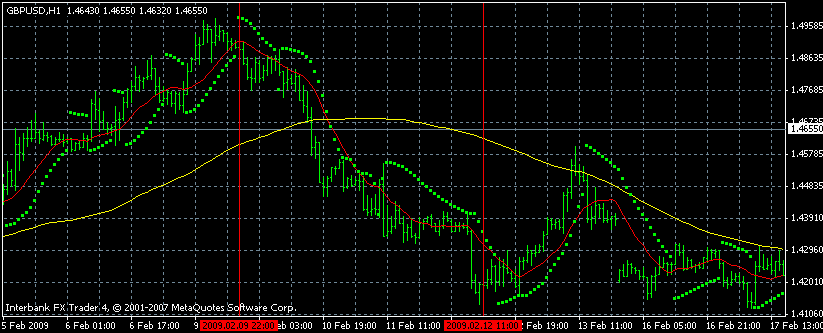
We will go along discussing the possible technical strategies that can be implemented by MA crossover on the same hourly chart of the GBP/USD pair. As before, the reddish line is the 13-hour SMA, the yellow line is the 100-hour SMA, while the dotted dark-green lie is the parabolic SAR. In order to make it more than convenient for the reader, we take delimited the menstruum we will report with the ii red vertical parallel lines on the chart. Learn more about the Parabolic SAR indicator here.
This fourth dimension, the change in the direction of the price activity is indicated by the parabolic SAR first, as it rises above the price, and signals a catamenia of downward motility at around 10 pm on February 9th. As expected, the toll enters the hourly downtrend, and keeps moving in that direction, and a brusk while later we receive the concluding confirmation of the hourly downtrend every bit an MA crossover occurs, with the thirteen-hour SMA moving below the 100-hour SMA, constituting an sell betoken for the trader.
Finally, the price collapses, and remains below the parabolic SAR to around xi am, February twelfth, when our signals are negated with the parabolic SAR rise above the price activeness. Similar to the to a higher place, if the trader had held his position from the fourth dimension of the crossover until the negation of the parabolic SAR signal, a 500 bespeak profit would be easily achievable. Fifty-fifty later the downtrend dissipates, all the same, the thirteen-hr SMA remains below the 100-hour SMA, demonstrating the unreliability of crossovers when used alone.
MA crossovers with Heiken Ashi
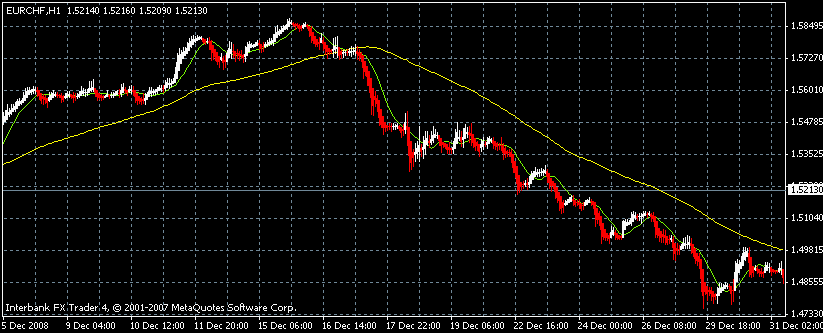
Using MA crossovers with the Heiken Ashi is both easy and elementary. In this hourly nautical chart of the EUR/CHF pair, nosotros denoted the 13-60 minutes SMA with lite green, while the yellow line depicts the 100-60 minutes SMA, every bit in the previous examples. The Heiken Ashi allows us to improve evaluate the strength and direction of the price action, and its coloring is more than solid than that of the candlestick nautical chart. Acquire more than about the Heiken Ashi indicator here.
On 16th Dec 2008, the price falls below both the thirteen-hour, and 100-hour uncomplicated moving averages, while at the same time moving average crossover occurs, as the thirteen-hour SMA itself moves beneath the 100-hour SMA. Apart from the moving averages, the Heiken Ashi too turns red, and confirms that a flow of down price activity is to be anticipated. All these expectations are realized as the Heiken Ashi remains overwhelmingly red for nearly thirteen days, and the price itself rarely manages to rise to a higher place the 13-day MA. Past using this strategy, the trader could take realized a thou –pip profit in but xiii days, while placing his stop-loss, or take profit lodge on the 100-solar day SMA.
MACD Crossovers
The MACD uses a 9-catamenia exponential moving average for its betoken line, and the indicator itself is the difference between the 26 and 12-menstruation exponential moving averages. Since the indicator is a number of moving averages combined in various ways to generate signals, the various methods which were discussed in the previous section on moving average crossovers tin as well exist used with the MACD. The important bespeak to call back is that the MACD is almost useless in a ranging market. The exponential moving averages are prone to generating many false signals in a ranging environment.
Divergence/Convergence is probably the most useful method for deriving signals form the behavior of the MACD. Still, the crossover of the indicate line tin likewise exist useful if it is used judiciously, and combined with different kinds of signals from other types of indicators its tendency to give false signals can exist eliminated to some degree.
In this section we will examine four different technical strategies which apply the MACD every bit a basis.
MACD Crossover with Difference/Convergence
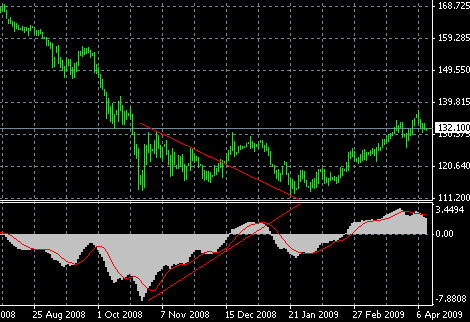
The about bones strategy utilizing the MACD crossover is the one which confirms the bespeak with a deviation or convergence between the price and the indicator. This scenario is thought to exist one of the rarer by technical analysts, and is consequently regarded as a great opportunity when it is identified.
In this daily chart of the EUR/JPY pair, the MACD reaches an extremely low level toward the finish of October, and rapidly begins an uptrend which culminates around the middle of Dec. The toll on the other manus, go on falling lower and lower even as the MACD rallies, and consolidates into a triangle pattern the upper side of which creates a convergence pattern with the MACD. At the same fourth dimension, The MACD's rally takes information technology right upward to the crossover line on 15th December 2008, where the price finally breaks the downtrend, and confirms the movement of the MACD with an upward breakout for an eventual profit of 600-800 pips if the trader made his entry close to the occurrence of the crossover. Indeed, the convergence between the cost and the indicator bespeak a longer term change, equally seen by the subsequent price action. A accept turn a profit club could have been realized when the MACD leveled out and stopped rising close to end of Dec. The chart stop for this strategy could exist either at the crossover line of the MACD, or on the upper side of the triangle for past the price action betwixt mid-Oct, and 15th January.
Divergence/convergence patterns are regarded as the most reliable signals generated by the MACD, only we'll examine them in greater detail after.
MACD Crossover with Heiken Aishi
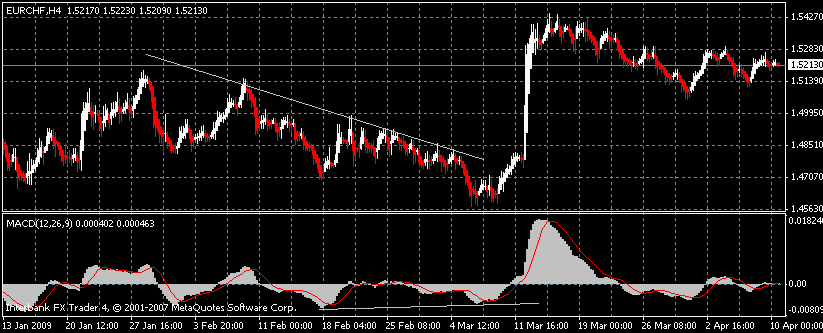
The chart shows the four-hourly toll action of the EUR/CHF pair between 13th January and 10th April 2009. Hither we volition apply the Heiken Aishi to confirm the MACD crossover. Right upwardly to effectually 11th March, the price moves in a volatile downtrend which forms a descending triangle between 27th January and 8th March. An interesting feature of the above graph is the existence of a slight but discernible convergence between the toll action and the indicator, as denoted by the white lines. Until March 11th, the crossovers on the MACD did non match a correspondent string of solid coloring on the Heiken Aishi, and as a result. at that place was no reliable pattern to trade.
On March 11th, nevertheless, not only does the MACD cross over the signal line, but also the Heiken Aishi begins to register a solid string of white bars which signal that the nature of the price activeness, and the attitude of market participants is in danger of reversing. And indeed, presently after the breakout of from the downtrend line stretching dorsum to 27th January occurs, the cost rallies with great speed, creating a long and solid white design on the Heiken Aishi, as the MACD keeps rallying strongly.
The entry point for this strategy, is the MACD crossover point over the signal line. The take profit order is executed when the MACD histogram (the cluster of white bars on the lower chart) begins to slope down.
MACD Crossover with Parabolic SAR
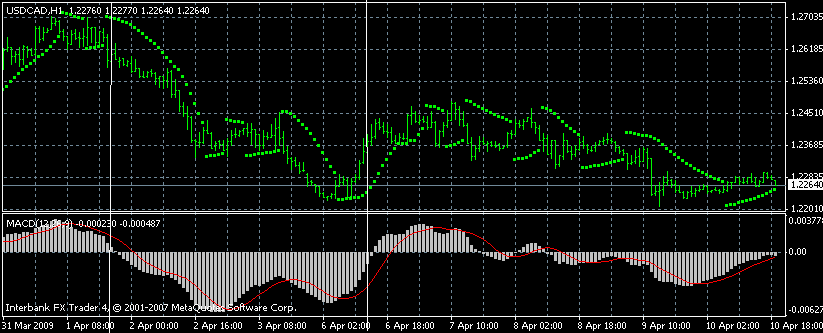
We will examine the MACD Crossover/Parabolic SAR strategy on the hourly chart of the USD/CAD pair. The lower nautical chart depicts the MACD, while the green dotted line on the upper draws the Parabolic SAR.
On this chart there are a number of actionable scenarios based on this strategy. Beginning from the left side, and around vii pm 1st Apr 2009, we discover the MACD crossing under the signal line, and a short while after that Parabolic SAR besides moves higher up the price, signaling an hourly downtrend. Every bit anticipated, the toll keeps moving down until around midday on the 2d Apr, when the parabolic SAR breaks its string of values above the cost, and starts emitting confusing signals. For this trade, the time when the crossover is confirmed by the Parabolic SAR would constitute our entry point, and nosotros would take our profit when the toll moved backed in a higher place the Parabolic SAR.
Sometime later, around midday on 6th April 2009, the Parabolic SAR moves under the price, and the MACD shortly follows and confirms it by rise above the signal line. Once over again the toll acts in line with our expectations, and keeps rising until the P. SAR moves below the cost. The upshot is a profit of around 100 pips, provided that the crossover is the entry betoken, and turn a profit is taken when the cost moves dorsum nether the P. SAR.
In gild to successfully use this strategy, the trader can use the Heiken Aishi confined instead of the ordinary bar charts and candlesticks. It is also possible to avoid false signals by because only the crossovers the slope of which is greater than, or equal to 45 degrees.
MACD Crossover with Fibonacci Time Series
Using the Fibonacci series with trend indicators such as the MACD can be a bit complicated at time. Because trends favor violent movements, the Fibonacci support, resistance, extension levels may not be very useful for providing guidance on profitable entry or leave points. The Fibonacci series is very flexible and useful however, and if we cannot employ it to evaluate the value of the cost action, it is notwithstanding possible to use it for measuring the length of the tendency's diverse phases. Learn more than about the Fibonacci ratios hither.
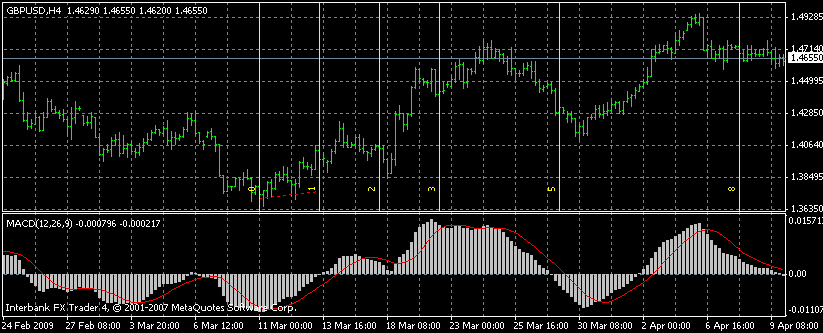
The chart in a higher place depicts the 4-hourly price activity on the GBP/USD pair. The yellowish vertical lines prove the fibonacci fourth dimension series, and the lower chart pairs the price action to the MACD. All we demand to do in social club to draw the Fibonacci fourth dimension series is to identify the extremes and crossover on the MACD, and to describe the first two yellow lines over them.
Every bit we tin can see conspicuously, the Fibonacci time series is very capable of predicting extreme on the MACD one time it is drawn. The periods i,two, 5 correspond to crossovers on the MACD, while 0 and iii are farthermost values. This strategy can be used in combination with one of the above, or can be used alone in lodge to decide on how long the trade must be open up. For instance, the crossover at 2 would non be indicate a buy lodge if it had not coincided with another period on the Fibonacci fourth dimension serial. But as it does, a purchase society could be opened, and held until the iii-menses of the series was reached, when turn a profit would be taken.
Stochastics Crossovers
The stochastics indicator is best used in a ranging environment; as a result the best results are gained by employing the crossover strategy in the presence of articulate support or resistance lines, breakout patterns. On the other paw, the stochastics indicator is very prone to generating many useless crossovers when the toll is consolidating, and it must be confirmed by other kinds of preferably non-oscillating indicators or patterns before reliable signals are generated. To remind the reader, when the blue line (slower component of the stochastics indicator), crosses over the scarlet line (the faster component) the crossover is bullish, and information technology is bearish in the contrary situation.
Hither nosotros'll examine four different strategies that can exist used with a stochastics crossover.
Stochastics Crossover with Support and Resistance Lines
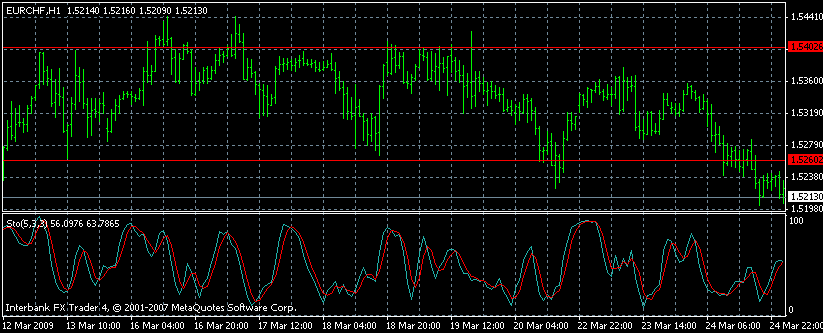
This is an hourly chart of the EUR/CHF pair, and the support and resistance lines are at 1.526, and 1.54. Between 12th March and 24th March, the price moves back and forth in the range established, and every bit a range pattern analysis tool, the stochastics indicator provided many actionable signals during this period.
Our trading strategy involves taking advantage of crossovers that occur close to the support or resistance lines which announce the limits of the price action. Since we are confident that a reversal close to the support/resistance lines volition point that the price action will go on in the established direction, we accept a good risk/advantage scenario for exploiting the crossovers. For instance, on 8 pm, 16th March, nosotros volition brusk the EUR/CHF pair, fifty-fifty before the price moves dorsum under the resistance line one time the failure of the breakout is established on the stochastics indicator equally the blue line(slower component) crosses under the cherry-red(faster component) line.. Effectually 4 am, on March 20th, we will buy the EUR/CHF pair, and concord information technology as the blue line crossover over the faster red line.
In using this strategy, we must require two different confirmations earlier we will open a position. The cost action close to the support or resistance lines must be vigorous, the stochastics crossover must non be reversed. In other words, we do non desire the price action to be confusing, and directionless close to the support or resistance lines, and then that we will not be whipsawed by a false breakout. Our finish-loss orders will be thirty-40 pips across the support/resistance lines, while the take profit lodge will be at the other side of the aqueduct delimited by them.
Stochastics Crossover with Breakout
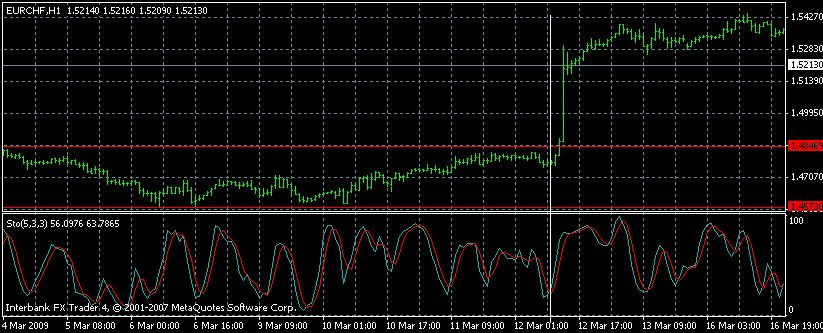
The stochastics crossover breakout strategy is the opposite of the stochastics crossover with back up/resistance lines strategy. In the latter, nosotros had attempted to benefit from the oscillations of the cost between the edges of the range; in this strategy, we'll attempt to identify and exploit a range breakout using a stochastics crossover.
The to a higher place graphic shows the hourly graph of the EUR/CHF pair, with a range divers between the resistance line at 1.4846, and the support line at i.457. The range holds for about 8 days between March 4th, and March 12th, until on the aforementioned date a violent breakout leads to an immediate 350-400 bespeak move to the upside. The breakout was signaled by a number of phenomena. Starting time, 11th March was a whole day of consolidation, as seen on the graph, with the cost confined into a very tight range. Second, the cost consolidation occurred very close to the master resistance line. Third, in order to fix the breakout, the stochastics indicator moved lower and lower, and stayed there until the breakout occurred.
The breakout was signaled by a crossover as the price moved beyond the range, and the cost action quickly confirmed the convincing nature of the crossover, in a menses of iv hours completing a breakout close to 400 points. The trade would be entered at the time of the crossover, both the stop-loss, and the take turn a profit order would exist defined by the chart, and be signaled by a surly crossover of the stochastics indicator. If the crossover occurred after a breakout, the accept-turn a profit order would be executed. If the crossover occurred before the breakout, the stochastics indicator would cause a cease-loss order to exist executed.
Stochastics Crossover with Parabolic SAR
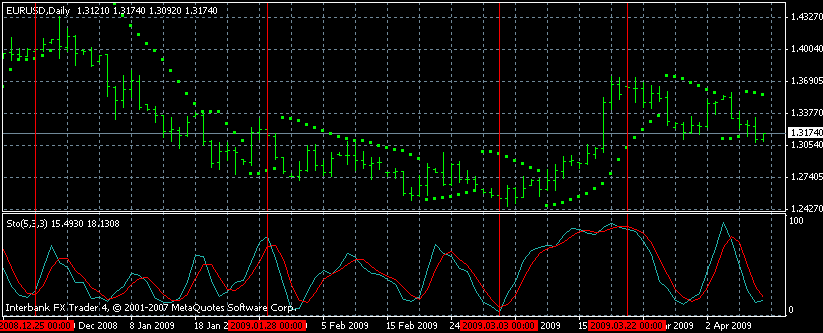
In this daily price chart of EUR/USD pair, we find four different signals generated by the confirmation of a stochastics crossover by the Parabolic SAR. The lower chart shows the stochastics indicator, while the dotted line on the upper depicts the Parabolic SAR. We volition examine the iii more reliable ones occurring around December 25th 2008, January 28th, 2009, and March 3rd. The last one on March 22nd is quickly contradicted past the confusing signs of the Parabolic SAR, every bit it moves upward and below the price without generating any meaningful signal.
A short while after the early hours of December 25th, every bit indicated past the large vertical line at the left side of the chart, the blue line of the Stochastics indicator moves below the red line, signaling that the upward movement of the price is losing its momentum. Soon after that, the Parabolic SAR also moves higher up the price activeness on the upper chart, and confirms the momentum change signaled by stochastics. Subsequently that, the stochastics indicator remains below the 50 level, and the price moves in a gently sloping downward trend from ane.xl down to i.27. The sell social club would be initiated when the crossover occurred, at around 1.iv, and the take profit point would be at about 1.3-1.31, as indicated by the rise of the stochastics indicator higher up 50, or by the Parabolic SAR moving below the price action. The cease-order would exist a chart stop, realized when the Parabolic SAR indicated an imminent up movement by moving below the cost.
In the second example, on January 28th, midnight, another crossover occurs on the stochastics indicator, with the bluish line once once again crossing beneath the cerise, every bit the Parabolic SAR rises to a higher place the price, both indicating an imminent downward movement. Nosotros apply the same entry/exit rules every bit in the previous paragraph, and depending on the timing, a profit of around 100 point is the result.
In the concluding scenario, where nosotros utilize the same rules to open or close the trade, we initiate the merchandise when the bullish stochastics crossover is confirmed past the Parabolic SAR moving below the cost. In this case the position is opened at 1.25, and closed at 1.31, with a turn a profit of effectually 600-pips.
The full general dominion is initiating these trades only when the price, and both indicators ostend the scenario which we have devised.
Stochastics Crossover with Heiken Aishi
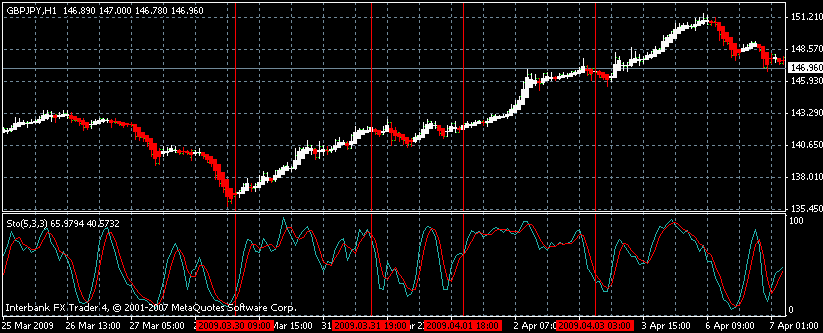
The chart is an hourly nautical chart of the GBP/JPY pair; the lower department shows the stochastics indicator, while the price action is depicted using the Heiken Aishi tool. The vertical lines indicate crossovers where the value of the stochastics indicators was irresolute rapidly. At such occasions, we endeavor to capture trend changes.
In using the Heiken Aishi chart with the stochastics indicator there volition be two rules for determining entry or leave points: We volition open a a position when a crossover occurs, and the colour of the Heiken Aishi changes, will maintain information technology until the value of the stochastics indicator falls below 50. After nosotros initiate the trade, we'll close the position when the Heiken Aishi bars change their colors, or the stochastics indicator makes a crossover to contradict our trade. For instance, if nosotros bought the currency pair on a string of white Heiken Aishi, we'll close it when there are more than four consecutive confined in the red. Let'southward see this with an case.
On March 30th 2009, around 9 am, a bullish stochastics crossover occurred, every bit indicated by the rise of the blue line over the reddish. Similarly, the Heiken Aishi chart changed its colors to white, after a long string of red before the crossover. Nosotros open a position at around 1.37, a little while after the crossover and color change occur.
After that, the number sequent cherry bars on the Heiken Aishi never exceeded four, and the stochastics indicator's value remained to a higher place l, until around midday Apr 1st. We close our position once the stochastics indicator moves beneath l, when the price is effectually one.31, and our account registers a 400 point profit.
Article Aqueduct Index with Fibonacci Time Serial
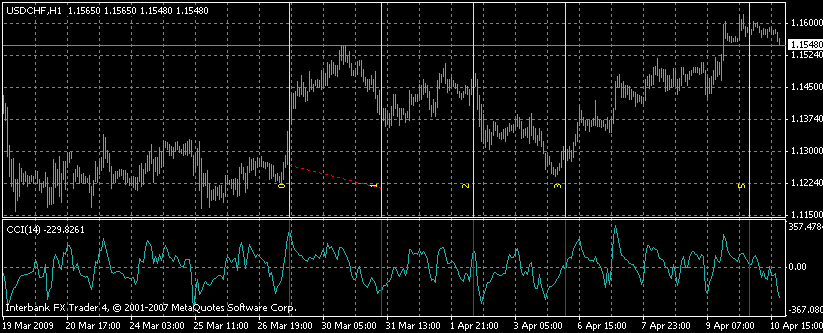
In this office we will non examine a crossover, merely will study another case on using the Fibonacci time series for confirming the activity on an indicator.
Every bit nosotros know, the commodity channel index was devised for commodity trading at first, due to its perceived utility in indicating cyclical changes of the price. The problem with this indicator arises out of the fact that the extremes registered on the price chart are extremes only on a relative level. At that place's no method for determining if an extreme value on the indicator will be invalidated by another, nonetheless more extreme value as time passes.
In lodge to overcome this problem with the CCI we're going to examine a strategy which attempts to confirm price extremes by the periods indicated past the Fibonacci Time series. In short, we will endeavour to match price extremes with the periods of the Fibonacci serial.
On the to a higher place hourly chart of the USD/CHF pair, the yellow vertical lines show the fibonacci time series, while the lower department depicts the CCI oscillator. We decided to regard the large breakout on 26th March 7 pm as the beginning of a new period post-obit the consolidation and range pattern prior to information technology. Thus, we begin the Fibonacci time serial at the CCI extreme matching the upswing. In order to define the closing point of the first period of the Fibonacci series, nosotros seek the lowest value of the CCI indicator following the farthermost at 7 pm, and find it on 31st March, where nosotros close the start menstruum of the Fibonacci series.
As it is clearly seen, the following progression of the Fibonacci Time Series matches extreme values remarkably well during the x days after the get-go period of the series. The 2-period, 3-period, and five-period all match price extremes on the nautical chart with cracking accuracy.
We will utilize such combinations of the oscillators with the Fibonacci Time series in order to divide the toll action into eras which can be used to turn a profit.
Decision
As nosotros have noted earlier, crossovers rarely generate reliable signals when used alone. Their reliability is even less with oscillators that fluctuate with greater frequency. Past matching the crossovers on the indicators with signals generated from the price activeness, the trader tin confirm the potential scenarios of his analysis with data from dissimilar sources, increasing reliability. Information technology is too possible to compound these signals with even more complex strategies, but nosotros will discuss the details of this subject in another article.
Further reading about forex indicators.
The simple moving average indicator explained with strategy and metatrader settings.
The exponential moving boilerplate indicator explained with strategy and metatrader settings.
The Heiken Ashi indicator explained with strategy and metatrader settings.

Forextraders' Banker of the Calendar month
ForexTime (FXTM) is an award-winning platform that certainly has the feeling of being fix up by people who know what they are doing. The business firm demonstrates an agreement of what helps traders make better returns, and its success tin can exist measured by the fact that it'south doubled the number of clients it supports in contempo years. The fact that the banker has grown to have more two million accounts suggests it is getting things right for clients.

Source: https://www.forextraders.com/forex-education/forex-strategy/technical-strategies-based-on-crossovers/
Posted by: hendersonfrosigh.blogspot.com
0 Response to "Forex Moving Average Crossover Strategy"
Post a Comment